|
| REPTILES ROCK!: Paleontologist Barbie loves the adventure of studying both modern and fossil reptile traces, as well as thinking artistically about the intricacies of her observations. (Photo by Hallellujah Truth) |
In July 2011 Paleontologist Barbie accompanied my brilliant Chiboogamoo to the Georgia coast to investigate modern alligator dens and gopher tortoise burrows on St Catherines Island. I was happy to interview Paleontologist Barbie about her interest in reptiles, modern and ancient traces, and her ongoing interests in the visuals arts that complement her scientific inquiries (To learn more about Paleontologist Barbie's rasion d'etre being art and science, read an earlier blog) .
 |
ALLIGATOR DEN ENTRANCE. Paleontologist Barbie, in a quest to better understand the fossil record of reptiles, decides to investigate some of the traces made modern alligators and sea turtles on St. Catherines Island, Georgia. “Why not take on the biggest and most dangerous reptiles first?” she asks, while checking out an alligator-den entrance. (Photo and caption by Anthony Martin) |
HALLELUJAH: Why study reptile burrows?
PALEONTOLOGIST BARBIE: First of all, because they are really cool! There are some burrows from almost 250 million years ago, for example, from South Africa made by synapsid reptiles that look like they lived in colonies underground. These synapsid burrows are complicated. Yet, when most people hear the word “reptile,” they don’t think “complicated.” Reptile burrows say otherwise.
HALLELUJAH: Could you define “burrow”?
PALEONTOLOGIST BARBIE: That’s a great question! You’d think it is straightforward, but it’s not. Because you can say “to burrow,” and that is a verb. But “a burrow” usually means it is an open structure made by an animal by digging in the ground.
HALLELUJAH: Yes….
PALEONTOLOGIST BARBIE: But digging in the ground doesn’t necessarily make a burrow.
HALLELUJAH: Can you explain that?
PALEONTOLOGIST BARBIE: Your dog can bury a bone in the backyard by doing just a little bit of digging, but that’s not a burrow. A burrow usually means it is going to be home where an animal lives.
HALLELUJAH: So as a paleontologist, you are mostly interested in ancient burrows or fossil homes?
PALEONTOLOGIST BARBIE: It is ALL good! I’m interested in both modern and ancient burrows. That’s why I went to St. Catherines Island. I wanted to learn about modern reptile burrows so I could compare them to ancient ones. Reptile burrows are documented for close to 250 million years from the geologic record.
HALLELUJAH: Can you explain why paleontologists study modern traces to interpret fossil ones?
PALEONTOLOGIST BARBIE: There is a principle in geology, and it’s a really long word but it’s worth knowing. It is called “uniformitarianism.”
HALLELUJAH: Okay….
PALEONTOLOGIST BARBIE: It means that what we see today may be applied to what has happened in the past.
HALLELUJAH: Can you give an example?
PALEONTOLOGIST BARBIE: Sure. On the Georgia islands, alligators make wide deep burrows that they use as dens. When we look at those modern burrows, we can use them as examples to compare to burrows made by animals similar to alligators in the fossil record.
 |
OBSERVING THE EPEHMERAL. “Well, this den looks occupied, judging from these fresh tracks and tail dragmark,” she points out, using her characteristically keen observation skills. She notes (with some sadness) that such traces are much less likely to be preserved in the geologic record as trace fossils, whereas the den, as a deep burrow, has a much better chance of making it into the fossil record. (Photo and caption by Anthony Martin) |
HALLELUJAH: Why conduct your studies about reptile burrows on the Georgia coast?
PALEONTOLOGIST BARBIE: First of all, Georgians are really lucky to have the barrier islands! Many of them still have their natural environments, which really help us paleontologists study living reptiles in their modern habitats.
HALLELUJAH: Isn’t there something special about the Georgia coast barrier islands that make them unique to the other islands along the eastern coast of the United States?
PALEONTOLOGIST BARBIE: Yes! Geologists call them “composite islands” because they’re made up of both modern sand and mud from two different time periods. The Pleistocene sand and mud was left more than 10,000 years ago. Then the Holocene deposits were made only in the past few thousand years. Of the more than 2,000 barrier islands around the world, this composite geology of both the Pleistocene and Holocene makes the Georgia barrier islands one of a kind.
HALLELUJAH: In geologic time, 10,000 years seems fairly recent…but then barrier islands are constantly forming, shifting and changing. I’m sure paleontologists will keep looking at our Pleistocene-Holocene barrier islands and learning new and relevant things!
What can you tell me about the alligator dens that you were looking at on St. Catherines Island with my Chiboogamoo?
 |
| MOTHER ALLIGATOR. A good mother dens with her young in a burrow on St. Catherines Island, Georgia. Notice the baby to the left of the photo! (Photo by Anthony Martin) |
PALEONTOLOGIST BARBIE: What’s really neat about these burrows is that they demonstrate family values. The mother alligator uses these burrows to protect the baby alligators. The dens are used as places where the babies can hide from predators, and the mother can stay in the den with them to ensure their safety.
HALLELUJAH: What’s significant about the alligator dens on the Georgia barrier islands?
PALEONTOLOGIST BARBIE: This is a very exciting research question that I am pursuing with your husband Chiboogamoo.
 |
| ANOTHER ALLIGATOR DEN. A dried-out pond on St. Catherines Island, Georgia, gave my Chiboogamoo and Paleo Barbie an opportunity to further investigate alligator burrowing. (Photo by Hallelujah Truth) |
 |
CONTINUING THE INVESTIGATIONS. Another alligator den beckons, its entrance obscured by tall grass. Does this stop Paleontologist Barbie? No! You might say she’s the honey badger of paleontologists. Stopping suddenly, Paleontologist Barbie hears the high-pitched grunting of a hatchling alligator nearby. “Whoa,” she says, but with much more feeling than Keanu Reeves. “This den is being used for brooding young! I’d better respect Momma Alligator and not spend much time here,” she says, neatly demonstrating that ethical concerns are often a part of scientific decisions. (Photo and caption by Anthony Martin) |
HALLELUJAH: Can you say something about your innovative research techniques?
PALEONTOLOGIST BARBIE: I can’t reveal that information yet because it hasn’t gone through peer review yet. I can say that we are applying cutting-edge, state-of-the-art technology that is going to kick butt—I hope you don’t mind that expression of enthusiasm!
 |
USING CUTTING EDGE TECHNOLOGY. Satisfied that this alligator den is worth further study, Paleontologist Barbie begins a cooperative research project with Sheldon Skaggs (left) and Kelly Vance (right) of Georgia Southern University. Here they are preparing to use ground-penetrating radar to make images of the alligator den. (Photo and caption by Anthony Martin) |
 |
YAH! “Let’s roll!” she says with her trademark enthusiasm for scientific endeavors. Sheldon and Paleontologist Barbie start the imaging of the alligator den by pushing the ground-penetrating radar device on the area that probably overlies the den. “If it weren’t so cliché to say so,” she says, “I would call this cutting-edge, state-of-the-art research.” Nonetheless, she makes a mental note to use those words in a grant proposal, knowing that no granting agency will fund her unless she uses those descriptors. (Photo and caption by Anthony Martin) |
 |
THE EXPERIMENT IS A SUCCESS! “Nice parabola!” she exclaims. The ground-penetrating radar unit, which emits high-frequency microwaves to reflect off produce its data, makes profiles based on differences of electrical conductivity just underneath the ground surface. In this instance, the higher parabolas (“bumps”) on the profile indicate the probable location of the alligator den. (Photo and caption by Anthony Martin) |
HALLELUJAH: I know that you are also looking at burrows of the humble gopher tortoise. Why?
PALEONTOLOGIST BARBIE: Well, the gopher tortoise may look humble, but their role in a longleaf pine—wire grass ecosystem is anything but humble. I caution you to remember that appearances can be deceiving (As Paleontologist Barbie winks, her long lashes flutter and she flicks her long curly black hair over her lean, attractive shoulders). That’s why I really identify with the gopher tortoise and am enjoying studying its burrow system. People often underestimate my intelligence because of my feminine appearance.
 |
| THE LANDLORD OF THE LONGLEAF PINE FOREST: A gopher tortoise out of its burrow. See the gopher tortoise blog written and posted by my Chiboogamoo on his website, Life Traces of the Georgia Coast. (Photo by Anthony Martin on Jekyll Island at the 4-H Center.) |
 |
| MEASURING THE SAND APRON. In January 2011, my Chiboogamoo began his investigations of gopher tortoise burrows with Kelly Vance and Sheldon Skaggs on St. Catherines Island, Georgia. (photo by Hallelujah Truth) |
HALLELUJAH: Paleo Barbie, you are certainly helping us change our perceptions of what it means to be a “girl”!
Well, can you briefly tell me about the gopher tortoise’s role in the ecosystem is?
PALEONTOLOGIST BARBIE: They are like the landlords of their ecosystems, but they don’t charge rent. Their burrows can hold more than 300 species of animals, including many rare ones like the indigo snake and the gopher frog.
HALLELUJAH: What are you learning about gopher-tortoise burrows through your investigations?
PALEONTOLOGIST BARBIE: Earlier, I said reptile burrows are thought to be simple but are actually complicated. We are finding that gopher tortoise burrows connect with one another, forming complex systems. See your husband's comments about these burrows in his blog, "Gopher Tortoises, Making Deep and Meaningful Burrows."
HALLELUJAH: Talk to me about your decision to work with my Chiboogamoo and Professors Sheldon Skaggs and Kelly Vance.
PALEONTOLOGIST BARBIE: They are fun guys and easy to work with. They love having somebody like me work with them. I’m fearless and unafraid of doing fieldwork. I jump into alligator dens and gopher-tortoise burrows with both booted feet. The advantage of my size permits me to do in-depth burrow research! Plus, it is great working with Sheldon, Kelly, and Chiboogamoo because they have done so much research on the Georgia coast.
HALLELUJAH: What kinds of precautions did you take while you were investigating the alligator dens and gopher tortoise burrows?
PALEONTOLOGIST BARBIE: You have to approach alligator dens very carefully. Fortunately, I’m very light footed, so they don’t usually detect me. Then gopher tortoises aren’t dangerous at all, but you still want to respect them and the animals that live in the burrows with them. That’s one of the reasons why we used new, non-invasive technology to study their burrows without disturbing them.
HALLELUJAH: Were there any other precautions necessary while you were out doing field research in this longleaf pine-wiregrass ecosystem?
PALEONTOLOGIST BARBIE: Yes! Protection against ticks, mosquitoes, gnats, and worst of all—chiggers! The female archaeologists there on St. Catherines were duct-taping their jeans around their ankles just to deter chigger bites! We all still wear sundresses in the evening at happy hour, so we all look festive while we discuss our findings, despite the horrible devouring of our flesh in the name of research! We also do regular tick checks!
HALLELUJAH: Finally, what do you hope to accomplish from these investigations?
PALEONTOLOGIST BARBIE: We hope to know more about the lives of alligators and gopher tortoises and how similar or different these lives were compared to reptiles of the ancient past. Investigations like these help us to better understand evolution!
HALLELUJAH: I know that in addition to your interests in science, you also like to go deep into the psychological realm because it informs your understanding of art. What kind of insights did you take away from your research about reptiles on St. Catherine’s Island?
 |
| ALLIGATOR ART. While on St. Catherines Island, Georgia, Paleo Barbie purchased a hand-built clay plate by Elizabeth Halderson, who grew up on the island because her father is the island manager. Elizabeth sells her work on an Etsy site. (Photo by Hallelujah Truth) |
PALEONTOLOGIST BARBIE: Because the alligators and gopher tortoises makes such intriguing forms and architectures with their burrows, I am inspired artistically to imitate or elaborate these forms in future artworks, so stay-tuned!
HALLELUJAH: Can you tell us the meaning that Native Americans assign to alligators and turtles?
PALEONTOLOGIST BARBIE: When I want to know the symbolic significance of an animal, I delve into Ted Andrew’s “Animal Speak” and recommend that everyone get a copy to deepen her connection with nature.
Briefly, the alligator, a symbol of power and fertility, represents primal energy and knowledge on two levels, both land and water. That’s awesome!
Then—about the gopher tortoise—well, turtles are ancient vertebrates that exist in mythologies around the world. The turtle, like the alligator, connects to a primal energy. For now, l will just say that the turtle should remind us of our connection with MOTHER EARTH. As the turtle inhabits its shell, we inhabit the earth. We have all we need right here, right now!
 |
| A SHOUT OUT FOR GOPHER TORTOISE ART. Paleo Barbie loves Elizabeth Halderson's hand built clay works! (Photo by Hallelujah Truth) |
HALLELUJAH: Yes, Paleo Barbie! Thank you for that—“We have all we need right here, right now!”
Will you be returning to the Georgia coast and St. Catherine’s Island?
PALEONTOLOGIST BARBIE: I hope so! This island is a fantastic natural laboratory for understanding how nature works, and it is a peaceful place. I get inspiration for both my science and art here!
ACKNOWLEDGMENTS: Great appreciation to my collaborator in LIFE, ART, and SCIENCE--Chiboogamoo! See his blog on our collaborative piece of art, "Abstractions of a Rising Sea," that we are exhibiting at the Fernbank Museum of Natural History through January 1, 2012. How fortunate we are to know and work with the naturalists and scientists along the Georgia coast! In this case, thanks to the magnificent staff of St. Catherines Island.
 |
| DISCOVERING THE TRACE MAKER. Tracking is especially exciting when you venture upon the animal that made the trace! (Photo by Hallelujah Truth) |
 |
| UNITING SCIENCE AND ART. Chiboogamoo and Hallelujah Truth at an alligator pond on St. Catherines Island, Georgia, in July 2011. (Photo by Sheldon Skaggs) |
 |
| PALEONTOLOGISTS AT WORK! Paleontologist Barbie provides scale for David Varricchio and Chiboogamoo as they photograph the mold of the sea turtle nest. (Photo by Hallelujah Truth) |
 |
SEA TURTLE NESTS. Switching her research interests from alligator traces on the inland environments of St. Catherines Island, Paleontologist Barbie checks out some sea-turtle nests. Because sea turtles have been around for more than 100 million years, their nests could show up as trace fossils in rocks from that time span. Working cooperatively with colleagues from Montana State University - David Varricchio, Frankie Jackson, Dan Lawver, and Mike Knell – they used polyurethane foam to cast a loggerhead sea-turtle nest. “So this is what it would look like in the fossil record!” she says with more than a little wonder in her voice. (Photo and caption by Anthony Martin) |
 |
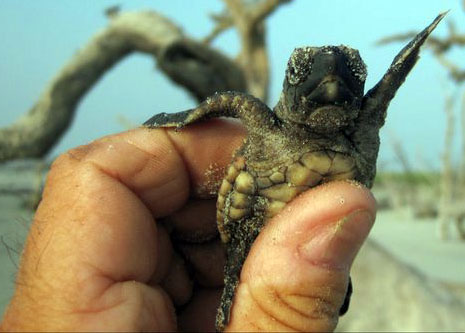
BABY SEA TURTLES! Some of the sea-turtle nests had been hatching their eggs, but not all of the baby sea turtles make it out of the nest without human help. This is where Gale Bishop often comes to their rescue, saving baby sea turtles wherever he goes on St. Catherines Island (St. Catherines Sea Turtle Conservation Program). In this case, it meant Paleontologist Barbie got to spend some quality time with a few loggerhead hatchlings and observe some of their trackways associated with their body movements. “They’re cute AND fantastic tracemakers!” she says. “I’ll definitely be back to do more research!” (Photo and caption by Anthony Martin) To read more about sea turtle nests and hatchinglings, read my blog: Sea Turtles Need Us: Relocating Nests on St. Catherines Island, Georgia. |