|
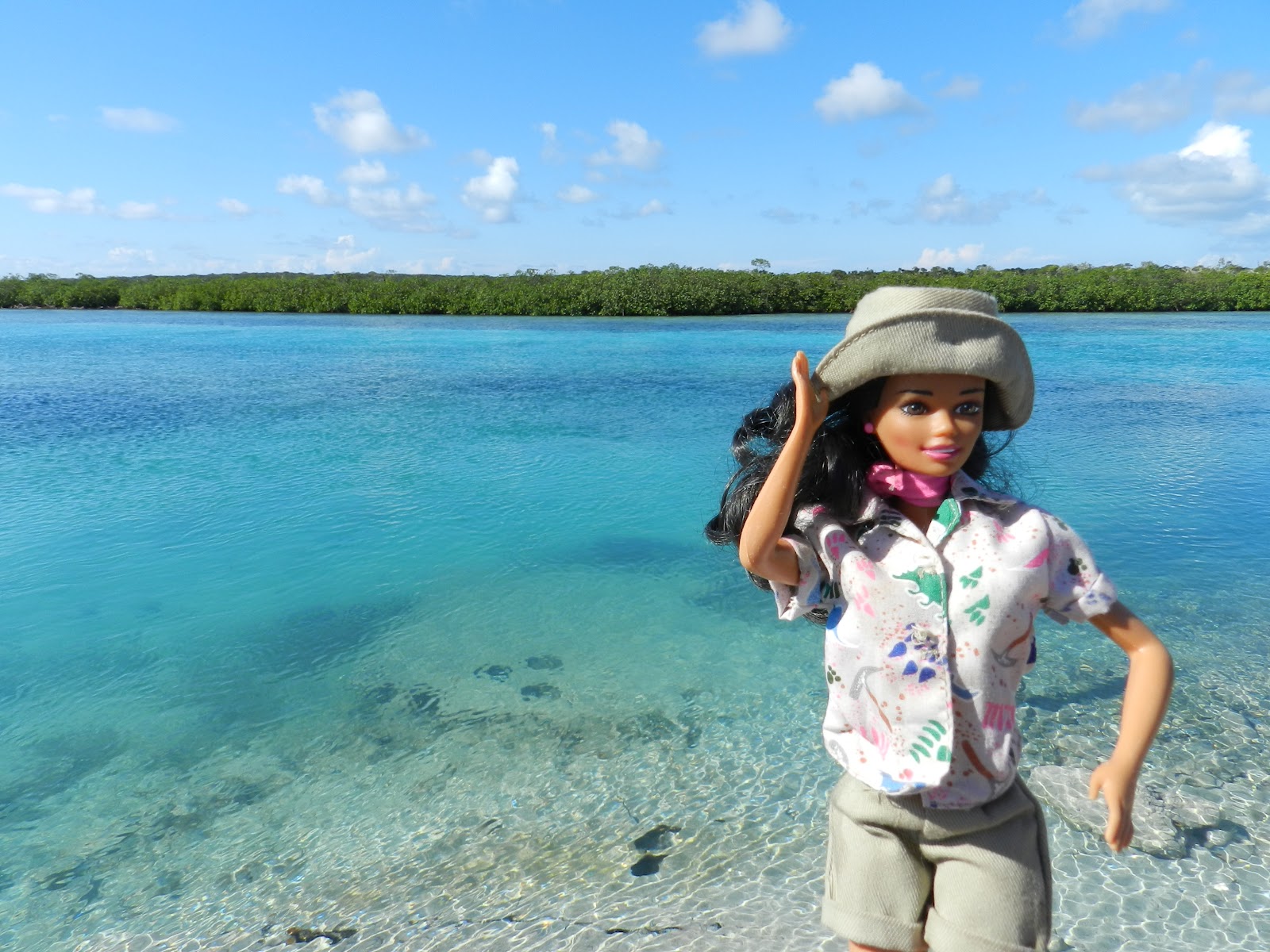
| ONLY THE SUPERIOR GO TO THE INTERIOR. Paleontologist Barbie on San Salvador, Bahamas, in the interior of the island, which is filled with poisonous plants, sharp rocks, and annoying mosquitoes! (photo by Hallelujah Truth) |
Right after Christmas 2011, Paleontologist Barbie collected her snorkel, mask, fins, sun screen, and superlative knowledge about how to teach the concepts of uniformitarianism out in the field, and headed to the farthest island on the Bahamian platform—San Salvador. Working alongside my Chiboogabmoo (aka, Tony Martin) and Stephen Henderson, her esteemed paleontologist colleagues, Paleontologist Barbie herded 12 Emory students to their spartan accommodations—the Gerace Field Station (GRC). Adapted from a US Naval base more than 30 years ago, the GRC is the perfect place for recovering from a hot day out in the field. The Bahamian staff prepare excellent meals three times a day and keep the compound equipped with a library, classrooms, labs, auditorium, and rooms are pristinely clean. Perfect for 11 days and 10 nights of science education exploring modern and ancient environments!
Paleontologist Barbie agreed to be interviewed here in Atlanta, Georgia, USA, as winter turned into spring and she got a moment free from her paleontological explorations along the Georgia coast.
 |
GERACE FIELD STATION VEHICLES. If you want to do field work on San Salvador, you have to use the field vehicles of the Gerace Research Centre to get around the island. Featuring natural air conditioning and absolutely no safety features, these vehicles give students and field veterans alike an experience they never forget. “I love doing field work!”, says Paleontologist Barbie as she clings precariously onto the back of the vehicle. (photo and caption by Anthony Martin)
|
 |
| BREAKDOWN OF FIELD STATION VEHICLE. Paleontologist Barbie was nowhere to be seen while Emory students and professors investigated an engine that wouldn't start. She was seen headed to the shore to do some ichnology. (photo by Hallelujah Truth) |
HALLEUJAH TRUTH: Why is San Salvador, Bahamas, an excellent destination to teach uniformitarianism using modern and ancient environments?
PALEONTOLOGIST BARBIE: San Salvador has sediments and rocks that are both made of calcium carbonate. And the calcium carbonate can cement really quickly. This means the sand they see today can become rock tomorrow. So the students get to find out how modern environments can become part of the rock record almost overnight, geologically speaking.
HALLEUJAH TRUTH: Why is a field course like this so important for students to experience?
PALEONTOLOGIST BARBIE: For one thing, it gets them outside. Much of their learning is in the confines of a college classroom. That's okay, but if they really want to learn paleontology and geology, we have to get them in the field. And in this class we're in the field every day.
HALLEUJAH TRUTH: What was the first thing you and your colleagues Chiboogamoo and Stephen Henderson did with the students after getting to the field station?
PALEONTOLOGIST BARBIE: We took a walk into the Precambrian. There is a lake on San Salvador, Storr’s Lake, that has such high salinity that nothing can live in it except bacteria, algae, and a few small snails and fish.
HALLEUJAH TRUTH: What is the lesson they learn there?
PALEONTOLOGIST BARBIE: Storr’s Lake has stromatolites, and it is one of the few places in the world that has those. These are hard-layered colonies of bacteria and algae that form dome-like structures. What’s really cool about these structures in Storr’s Lake is that they are very much like stromatolites from the fossil record going back more than 3 billion years ago.
 |
STORR’S LAKE—GOING INTO THE PRECAMBRIAN. One of their first destinations is Storr’s Lake, a hypersaline lake that has almost double the salinity of normal sea water. This lake has modern stromatolites - layered structures made by photosynthetic bacteria and algae – which were commonly fossilized in rocks from more than 500 million years ago. Because this is one of the few places in the world where people can see modern stromatolites, Paleontologist Barbie is thrilled to be here. “Welcome to the Precambrian!” she says with Archean aplomb. (photo and caption by Anthony Martin) |
 |
PALEONTOLOGICAL COLLEGIALITY. The water is too deep for Paleontologist Barbie, though, so she gratefully accepts a ride into Storr’s Lake in Chiboogamoo’s shirt pocket. “Hey, look at me, I’m a pocket protector!” she shouts playfully. (photo by Hallelujah Truth, caption by Anthony Martin) |
HALLEUJAH TRUTH: Why do you have students walk into Storr’s Lake?
PALEONTOLOGIST BARBIE: We want them to experience what it is like to be in the Precambrian before animals were ruling the earth. Instead, bacteria and algae are ruling Storr’s Lake. Isn’t that neat?
HALLEUJAH TRUTH: Can you tell us more about stromatolites?
PALEONTOLOGIST BARBIE: Sure, I love stromatolites! Sometimes they look like cabbages. Some times they look like cauliflowers or maybe a weird onion. They have layers on top of layers where the ones on the bottom are the oldest and are the remnants of bacterial and algal colonies. The layers on the top are living colonies, so this shows how they grow upwards towards the light because these bacteria and algae are photosynthetic. That is one of my favorite words—photosynthetic!
So let’s see the formula for photosynthesis is 6H2O + 6CO2 (sunlight) --> C6H12O6 + 6O2 (Paleonotolgist Barbie giggles as she sings the formula for photosynthesis out loud from memory!)
HALLEUJAH TRUTH: At Pigeon Creek, where you give students the opportunity to snorkel, you also give a lesson about harvesting conchs.
PALEONTOLOGIST BARBIE: Pigeon Creek is a beautiful lagoon that empties into the Atlantic Ocean from a tidal creek. I always love going there, but I'm also made sad by the piles of dead conch shells on the shore. All of these conchs were killed by people for food. But people have taken so many of them that there aren’t very many left anymore. I tell students that conchs shouldn’t be harvested if they don’t have a lip, which means they’ve reached the maturity to reproduce.
 |
CONCERN FOR CONCHS AT PIGEON CREEK. At their next location – Pigeon Creek, a lagoon on the south end of San Salvador – Paleontologist Barbie shows some concern for conservation of modern species native to the Bahamas. During the past few decades, the queen conch (Strombus gigas) has been overharvested in the Bahamas, leading to a huge decline in their numbers. One of the tell-tale signs of this overharvesting are piles of their shells, all bearing puncture marks from where people killed them. “Save the conchs!” says Paleontologist Barbie. As an effective science communicator, she knows that this is a much better rallying cry than, say, “Preserve the large endemic modern marine gastropods!” (photo and caption by Anthony Martin) |
 |
REVELING IN THE BEAUTY OF PIGEON CREEK. Aside from the piles of dead conchs, Pigeon Creek is a beautiful lagoon, ringed with mangroves and bearing white sand and mud on its bottom. On and in this sediment are lots of bivalves and abundant crustacean burrows. “Hmmm, I wonder if anything like this lagoon is preserved in the Pleistocene rocks here, with fossil bivalves and crustacean burrows,” she wonders. (photo and caption by Anthony Martin) |
HALLEUJAH TRUTH: What else do you have students look for in Pigeon Creek?
PALEONTOLOGIST BARBIE: Because Pigeon Creek is a lagoon, it has lots of mud, burrowing shrimp, clams, and mangroves along its edges. Some of these get preserved in the fossil record, some don’t. We ask students, “What would you expect to see from this lagoon in the fossil record?”
HALLEUJAH TRUTH: I can see that this particular aspect of teaching in the field delights you. You can talk about this excitement?
PALEONTOLOGIST BARBIE: We get to use our minds and our bodies at the same time. If you are snorkeling over a reef, you are physically engaged but at the same time you are identifying the corals, examining the fish and their behavior, and figuring out how those whole ecosystems are working. I can’t think of anything more fun to do in the field--having fun while having deep thoughts.
HALLEUJAH TRUTH: Do you give students maps of San Salvador? What do you want them to learn about navigation?
PALEONTOLOGIST BARBIE: Yes, we do give them a map of San Salvador. Maps are really cool tools! We want them to learn how to use them. Every day we like to ask the students to point to north. The first day they're pretty bad at it. By the second or third day, they are starting to understand how the position of the Earth’s Sun—and I like to call it the Earth’s Sun because of my interest in astronomy—tells them which way is east, south, west, and north.
The maps help them too, because when we see a big lake or a lagoon or different cays that are offshore, those can also help the students understand where they are. So they then get what a lot of people call “a sense of place.”
HALLEUJAH TRUTH: Yes, “a sense of place”—I like that idea! And it is also good to see how this “one place” or an island like San Salvador can be so different from one end to the other. Can you say something about these differences?
PALEONTOLOGIST BARBIE: Excellent question! The southwestern end of the island is called Sandy Point, which is because it has the most sand-duh! But that is totally different from the northeastern end of the island that has a rocky coastline made from rocks formed about 5,000 years ago.
HALLEUJAH TRUTH: You use the terms, bioerosion, limestone, Pleistocene Epoch, trace fossils, can you give me a quick lesson here?
PALEONTOLOGIST BARBIE: Sure. Bioerosion just means the process where animals and plants wear down rock. So some snails, for instance, are chowing down on algae that might be on coastal rocks. While they are scraping that algae, they are also breaking down the limestone. Parrotfish--those are my favorite bioeroders--they crunch on coral to get the algae. And I am embarrassed to say it, but what comes out the other end of the parrotfish is the sand that you end up lying on along the beach! Ewww!! (Paleontologist Barbie smiles devishly.) That’s right, most of that beautiful white sand on a beach in the Bahamas is parrotfish poop!
I guess I could write a dissertation on each of those topics, bioerosion, limestone, Pleistocene, and trace fossils. So I'll just summarize here: There are Pleistocene and Holocene rocks that have trace fossils on San Salvador. These trace fossils tell you what environments made the limestones.
 |
POSSIBLE TRACES IN THIS LIMESTONE? At one San Salvador outcrop, Paleontologist Barbie becomes interested in the texture of the limestone, wondering if this was caused by tiny burrowing animals (like ants) or non-biological causes. “Wow, there’s so much more research that can be done here!” (photo and caption by Anthony Martin)
|
 |
WHOA, BIOERODERS! On the south end of San Salvador, Paleontologist Barbie is thrilled to see some examples of modern rocky intertidal gastropods, which graze on the algae on the coastal limestones by scraping down the rocks. “Whoa, bioerosion in action!”, she says. (photo and caption by Anthony Martin) |
 |
TRACES IN LIMESTONE. This same coastal limestone is from the Pleistocene Epoch, and is estimated as more than 100,000 years old. Thus Paleontologist Barbie is intrigued to see a possible fossil trails preserved in the limestone. “Well, it’s either from a gastropod, or a modern root trace,” she says, keeping in mind how every good scientist should consider alternative explanations for what they observe in the field.(photo and caption by Anthony Martin) |
HALLEUJAH TRUTH: About trace fossils….How can a root make a trace? It doesn’t have behavior does it? I’m evoking my understanding of your and Chiboogamoo’s concept of The Holy Trinity of Ichnology: substrate, anatomy, and behavior.
PALEONTOLOGIST BARBIE: Plants behave! You’ve seen a Venus fly trap? Lots of other plants react to their environments or change them by behaving. So this behavior changes any sand or substrate that might be around them. And with roots being part of a plant’s anatomy that makes root traces an example of the holy trinity of ichnology—substrate, anatomy, and behavior—Amen! (Barbie puts her hands together in a prayerful look.)
 |
ROOT TRACES—PLANTS DO BEHAVE! Also in this limestone are some fossil root traces, indicating that the former environment was on land. The root traces were also in a former dune deposit, and probably formed during a sea-level low in the Pleistocene. “Root trace fossils are awesome paleoenvironmental indicators!” she states emphatically. (photo and caption by Anthony Martin) |
HALLEUJAH TRUTH: What do you want students to understand about modern coastal dunes?
PALEONTOLOGIST BARBIE: Most of the rocks on San Sal are fossilized dunes from the Pleistocene and Holocene Epochs. These dunes have gorgeous cross-bedding, root trace fossils, insect burrows, and other evidence of environments formed when sea level was low. When students look at modern dunes, we want them to see how those can be related to what they are seeing in the geologic record. Most of the same things are there, and all they have to do is look carefully to see them.
 |
NEOICHNOLOGY IN THE DUNES. This quick look at a Pleistocene dune deposit encourages Paleontologist Barbie to look at some modern dunes on San Salvador, which are on the southwestern end of the island at Sandy Point. Here she observes the tracks of a yellow-crowned night heron (in front), the trackway of a giant purple land hermit crab (behind her), and some sea grapes (also behind her), which no doubt are making some modern root traces. “Looks like we got some neoichnology going on here,” she says gleefully. (photo and caption by Anthony Martin) |
 |
TRACKING IN MODERN COASTAL DUNES. At some point, Paleontologist Barbie follows the tracks of the yellow-crowned night heron to see where it started. She is soon rewarded by the sight of two parallel tracks, in which the rear toe on each track dragged in the sand as the heron landed. “Wow, wouldn’t it be cool to find something like this in the fossil record!” she muses. (photo and caption by Anthony Martin) |
 |
DETECTING HERMIT CRAB TRACKWAY. Even more impressive than the heron tracks, though, are the numerous long trackways of giant purple land hermit crabs. The shell dragmark can be seen in the middle of the trackway, and the tracks were made by the hermit crab’s four walking legs. “Keep in mind that hermit crabs are not true crabs,” she explains helpfully to the students, reminding them to pay proper attention to taxonomy. (photo and caption by Anthony Martin)
|
 |
CONSIDERING EVIDENCE. Another view of Paleontologist Barbie studying the trackway, in which she also notes the long stem of a bay geranium behind here. “So horizontal vine traces and hermit crab tracks preserved in the rock record would be convincing evidence for a former dune environment,” she says confidently. She is, of course, correct. (photo and caption by Anthony Martin) |
HALLEUJAH TRUTH: So San Salvador really provides an excellent outdoor classroom to teach the concept of uniformitarianism! I know that you were excited about showing the students the holotype of a ghost crab burrow after they saw numerous modern ghost crab burrows on Sapelo Island, Georgia, USA. Could you explain what a holotype is and why this one made by a ghost crab is so thrilling?
PALEONTOLOGIST BARBIE: Wow! That was the most exciting part of the trip, to see the holotypes for two trace fossils in the field! The ghost crab burrow, Psilonichnus, was only one of them. A holotype is a specimen that paleontologists use to compare to all other fossils that might be like it. Usually, holotypes are in museums. The holotype of Psilonichnus is in a limestone outcrop and could not be collected, so there it is almost 30 years after it was first named as a holotype still there in the outcrop!
I feel like I am a part paleontological history every time I go to San Salvador and visit Psilonichnus! I absolutely adore ghost crabs. They are such complicated animals. Did you know that they have little gills and little lungs? That means they can live part of the time on the land, but they have to go to the water to wet their gills. They are perfect examples of what evolutionary biologists call transitional animals! And you know I love evolution!
 |
PSILONICHNUS. San Salvador’s rocks is the renowned home of a very special and well-loved holotype specimen, called Psilonichnus. This is a Y-shaped burrow that was likely made by a ghost crab, in which each of two entrances at the top of the burrow formed the upper part of the “Y.” Seeing it requires a rugged hike along a rocky coast, but Paleontologist Barbie was up for the challenge. Here she points to the “Y” while also admiring the well-defined cross-bedding in the limestone. (photo and caption by Anthony Martin) |
HALLEUJAH TRUTH: Wasn’t it physically challenging for the students to get to the site of this Psilonichnus? Rocks that cut if you fall and an encroaching tide?
PALEONTOLOGIST BARBIE: Oh yeah! That was part of the adventure. And I’m all about adventure--leading by example is the best way for students to figure out how they are going to get through tough conditions in the field. Sometimes I have been nicknamed "the honey badger of paleontologists." I don’t deny it. I want the students to be inspired–plow through those environments with me.
HALLELUJAH TRUTH: You mentioned another holotype located on San Salvador?
PALEONTOLOGIST BARBIE: Oh, thanks for reminding me. It’s the only fossil hermit crab trackway known in the world, Coenobichnus. One of my heroes in paleontology, Dr. Sally Walker, described and named this trace fossil holotype, which is on North Point on San Salvador not far from the field station.
 |
COENOBICHNUS! Imagine the excitement felt by Paleontologist Barbie when she saw the only known fossil hermit crab trackway in the world, which is also on San Salvador. Reported by Dr. Sally Walker and two other paleontologists in 2000, this trackway was named Coenobichnus, and it is the type specimen to which any similar trace fossil would be compared. “Dr. Walker is my hero!” she exclaims. (photo and caption by Anthony Martin) |
 |
COENOBICHNUS CLOSE UP. Paleontologist Barbie has learned that to truly see a trace, one should get as many different perspectives as possible. (photo by Anthony Martin) |
HALLEUJAH TRUTH: I know one of the most exciting sites for students is seeing the fossil coral reef on San Salvador! I would love for you to explain their “wow”!
PALEONTOLOGIST BARBIE: Wow is the right reaction! By the time we go to the fossil coral reef, the students have already snorkeled several times along modern fossil reefs. This fossil coral reef is from about 130,000 years ago and because it is now on land, it shows the students that sea level was much higher way back then. What’s also amazing for the students to see is how the same species of corals they can see in a modern reef are preserved as fossils in this reef. They can make the comparison between the modern and fossil reefs with almost no effort at all—that is, can you spell it?—U, N, I, F, O, R, M, I, T, A, R, I, A, N, I, S, M!
HALLEUJAH TRUTH: Do you have a favorite fossil coral?
PALEONTOLOGIST BARBIE: Great question! If I had to narrow down my favorite fossil coral to one, I’d have to say those huge fossil brain corals of the genus Diploria. They make fantastic complicated patterns that just bring out the artist in me!
 |
FOSSIL CORAL REEF! But Paleontologist Barbie did not come to San Salvador just to see trace fossils: she wanted to have it all, and check out some body fossils, too. Fortunately, an excellent exposure of a fossil reef is on the west side of the island. This reef, which formed about 130,000 years ago when sea level was about 6 meters (20 feet) higher than today, has many examples of fossil corals. “Hey, that looks like a species of Meandrina, a brain coral!” Yes, indeed it is. (photo and caption by Anthony Martin) |
 |
FOSSIL CLUB-FINGERED CORALS. At this same fossil reef, Paleontologist Barbie also encounters a dense accumulation of club-fingered corals, with the repetitive species name Porites porites. “I wonder if this species was ever mentioned on the TV show ‘Mary Hartman, Mary Hartman’,” she jokes, a generational reference that was completely lost on the students. (photo and caption by Anthony Martin) |
 |
OMG! IT’S OPHIMORPHA. In between all of these coral body fossils was an exposure of the trace fossil Ophiomorpha. These fossil burrows were likely made by burrowing shrimp in the sandy areas around the reef, and are easily identified as a series of tubes (similar to The Internet). These burrows also have knobby walls where the shrimp pasted pellets into the sides of the burrows to reinforce them. “We’ve seen modern examples of these on Sapelo Island, too” she reminded the students, who dutifully took notes on everything she said. (photo and caption by Anthony Martin) |
 |
| AGAIN OMG! CORALLITES! Potentially confused with these burrows are staghorn corals (Acropora cervicornis). “Nice corallites!”, she observes. Corallites are the places where the individual animals in the coral colony lived, which can be seen here as the pointed holes on each colony. (photo and caption by Anthony Martin) |
 |
FOSSIL EVIDENCE OF PREDATORY GASTROPODS! A great two-for-one special, paleontologically speaking, are two fossil bivalves with trace fossils in them: drillholes made by predatory gastropods that killed these bivalves more than 125,000 years ago. “Hey, I have one of those, too!” she says with amusement at the hole in her hand, where she used to wear a ring (which was very impractical in the field, though). Regardless, she thinks of another paleontologist hero of hers, Dr. Patricia (Trish) Kelley, who studies these trace fossils and figures out how they reflect the evolutionary history of predatory gastropods. (photo and caption by Anthony Martin) |
HALLEUJAH TRUTH: You were on San Salvador for 11 days and 10 nights, what was the most exciting geological phenomenon for you?
PALEONTOLOGIST BARBIE: Two things--one which is occurring very slowly and the other which is happening dramatically. The slow one is bioerosion. When you see millions of snails and chitons scraping the coastal rocks, you see how rocks can get worn down day by day over time. The dramatic one is waves. These waves are smashing persistently against the same rocks being worn down by bioeroders. The rocks don’t stand a chance against these two things!
HALLEUJAH TRUTH: While you are witnessing all these dramatic and fantastical aspects of geology on San Salvador, you must need sustenance, what can you say about the Gerace Research Center's food?
PALEONTOLOGIST BARBIE: I love it! Every morning, we had a hardy breakfast of pancakes, French toast, or scrambled eggs. For lunch, we either had sandwiches with homemade bread in the field or a hot three-course meal at the field station. Then dinner was always delicious in its abundance of meat and vegetarian dishes. Meals were very satisfying. The Bahamian field station cooks really know what they are doing. I felt like applauding them every night, and I did!
 |
FIELD STATION SUSTENANCE. At the start of each day, the cafeteria at the Gerace Research Centre serves a delicious and hearty breakfast to the students, professors, and researchers, which helps to fuel them for fieldwork. Normally Paleontologist Barbie is a vegetarian, but here she makes an exception when they give her some bacon to go with her pancakes. “If only this bacon were made from feral hogs, then I wouldn’t feel so guilty about eating meat,” she laments. (photo by Hallelujah Truth caption by Anthony Martin) |
HALLEUJAH TRUTH: Now Paleontologist Barbie, I know that you are first and foremost interested in non-human research, but you did take the students to some archaeological sites. Why?
PALEONTOLOGIST BARBIE: San Salvador has a unique place in human history. This is where Christopher Columbus probably landed. I don’t have to give you any more details to let you know how important this island is to the rest of the world.
 |
IT’S NOT PALEONTOLOGY, BUT…On January 1, Paleontologist Barbie and the students study the human history of San Salvador, which goes back about 1,000 years, starting with the Lucayan people, which was followed by Columbus landing in 1492, then British plantations in the late 18th and early 19th centuries. Although Paleontologist Barbie strongly dislikes being confused with archaeologists, she still enjoys learning about this plantation ruin at the south end of the island. (photo by Hallelujah Truth and caption by Anthony Martin) |
 |
WOW! A FOSSIL IN ALL THAT ARCHAEOLOGY. Not deterred from doing paleontology at this site, though, Paleontologist Barbie discovers a fossil gastropod in one of the rocks placed in a plantation-building wall. “Why, I think that’s Cerion, a terrestrial pulmonate gastropod and of the same genus studied by Stephen Jay Gould when he devised punctuated equilibrium as an evolutionary hypothesis,” she says matter-of-factly, impressing the students with her scientific knowledge. (photo and caption by Anthony Martin) |
HALLEUJAH TRUTH: One of the geologists, Larry Davis, who has been researching fresh water on San Salvador for close to 30 years, has a saying, “Only the superior go into the interior.” What does this mean and why do you and my Chiboogamoo take your students to the interior of San Salvador away from the beautiful turquoise water and white sandy beaches? PALEONTOLOGIST BARBIE: Hey! If you are going to be a REAL PALEONTOLOGIST or a REAL GEOLOGIST, you have to go into tough places. The interior of San Salvador has pointy and poisonous plants, sharp limestone underfoot, lots of parasitic insects, and can be just plain miserable. I LOVE it!
We go there to see some of the Pleistocene rocks that have fossils showing how that part of the island was once a lagoon, just like the modern one we saw in Pigeon Creek! So if we didn’t go to the interior, the students would never make that connection. Repeat after me: U, N, I, F, O, R, M, I, T, A, R, I, A, N, I, S, M!
 |
INTO THE INTERIOR. Paleontologist Barbie LOVES leading the students into the interior of San Salvador to observe the modern environments and outcrops there. One of the stops is at an inland lake, but one different from Storrs Lake. “Looks like normal marine salinity to me,” she astutely discerns. (photo by Hallelujah Truth and caption by Anthony Martin) |
 |
AN ENTHUSIASTIC BOTANIST. While on the trail, Paleontologist Barbie indulges in some botany by getting into a large bromeliad, also known as an “air plant” because it lives above the ground and derives much of its nutrients from the air. “I’ve heard of ‘air heads,’ but not ‘air plants,’”, she giggles, followed by a detailed explanation of the evolutionary history of the Bromeliaceae. (photo by Hallelujah Truth and caption by Anthony Martin) |
 |
TAKING RISKS TO LEARN. Paleontologist Barbie is very excited to get up close and personal with a giant purple land hermit crab, a terrestrial hermit crab that uses the shell of a marine gastropod (West Indian top shell) as its mobile home, and the same species that made the long trackway she saw several days before. “Hey Sigourney Weaver, check this out!” she says, in an obvious reference to the “Alien” movies. (photo by Hallelujah Truth and caption by Anthony Martin) |
 |
EPILITHIC. On the shore of one of the inland lakes, Paleontologist Barbie notes the presence of thin-shelled mussels that attach to the limestone there. “Epilithic!” she shouts instead of “Epic!”. That’s Paleontologist Barbie for you: getting all multisyllabic on us. (photo Hallelujah Truth and caption by Anthony Martin) |
 |
MOONROCK? Sometimes the limestone bedrock in the interior of San Salvador gets eroded so that it makes lots of holes on the top surface, a feature called “epikarst.” So Paleontologist Barbie takes full advantage of it, doing a little bit of spelunking on her own while on the shore of Moonrock Pond. (photo and caption by Anthony Martin) |
 |
DEPOSITS FROM A FORMER LAGOON? Because Paleontologist Barbie always has her eyes close to the ground, looking for fossils, she easily spots some bivalve fragments in rocks along the trail. “Say, isn’t that Codakia, the bivalve we saw in Pigeon Creek, that lagoon we swam in the other day?” she asks. She’s right, it is, so this might be a former lagoon deposit from the Pleistocene Epoch. But how to further test this hypothesis? (photo and caption by Anthony Martin) |
 |
“CRUSTACEAN TRACE FOSSILS – YES!” Paleontologist Barbie shouts excitedly. Just a little further down the trail, she correctly identifies some fossil burrows that were likely made by burrowing shrimp of the same species that burrow today in Pigeon Creek. This is how science is done, folks. (photo and caption by Anthony Martin) |
 |
MICROMORPHIC MOLLUSCANS. Near one of the inland lakes but in the forest is a deposit of small gastropods and bivalves that must have come from the lake. This is a storm deposit from Hurricane Floyd, which hit San Salvador in 1999 and caused high waves in the lakes, which carried these shells into the nearby woods. “I admire micromorphic molluscans!” she says alliteratively. (photo by Hallelujah Truth and caption by Anthony Martin) |
HALLEUJAH TRUTH: Did you and the students have any leisure time during the 11 days you were on San Salvador?
PALEONTOLOGIST BARBIE: Well, not much during the day. There was no time to lie on the beach and get a tan. But at night, sometimes we walked the mile-and-a-half to the nearest bar, called The Short Stop. This is a long time tradition for geologists, paleontologists, and biologists to go to the Short Stop and talk about what we learned during our time in the field while quenching our thirst. We also spent New Year’s Eve there, so the students got to experience a little bit of Junkanoo, which is the Bahamian New Year’s festivities.
 |
| A GEOLOGIST’S TRADITION. After a hard day of fieldwork, it’s time to relax and discuss geology and paleontology the way it’s traditionally done, which is at a local bar. About a 25-minute walk from the Gerace Research Centre is The Short Stop, a Bahamian bar where many professors and students have conducted earnest debates about their scientific findings that day while quenching their thirst. Here Paleontologist Barbie joins in, and orders a Kalik, a Bahamian beer. “This is as big as the beers in Australia!” she says, thoroughly impressed. (photo and caption by Anthony Martin) |
 |
| SHORTSTOP WALL ART. (photos by Anthony Martin) |
HALLEUJAH TRUTH: Yes Paleontologist Barbie, I know you enjoyed your Kalik and the ART on the walls of the Shortstop. I always like to discuss ART with you since you see a natural connection between science and art. What did you think of the sculptures made by San Salvador’s master woodcarver, Kenny Whitfield?
 |
| KENNY WHITFIELD, MASTER WOOD CARVER, SAN SALVADOR, BAHAMAS. To learn more about Kenny Whitfield and his ideas about his art, see Hallelujah Truth's interview with him. (photo by Anthony Martin) |
PALEONTOLOGIST BARBIE: I thought his carvings were brilliant! It was amazing to watch him work so quickly but so precisely. He would take a hunk of wood and instantly transform it into a sea turtle, a sea star, or a grouper!
HALLEUJAH TRUTH: Let’s wrap this interview up! You have been to San Salvador many times, but I know you always look with fresh new eyes. What did you discover on this visit that you hadn’t seen before?
PALEONTOLOGIST BARBIE: You’re right! I always try to really look for something new because I know nature is always changing. This time I was especially attentive when we went to Sandy Point. I had a blast looking at all the tracks there! I also imagined how those tracks might get preserved in the fossil record! Who knows? Some day, tracks just like those of the hermit crabs and herons might be found in the rocks of San Salvador.
 |
| WE THREE IN STORR'S LAKE, SAN SALVADOR, BAHAMAS. Chiboogamoo, Paleontologist Barbie, and Hallelujah Truth posed for this photo after the lecture on stromatolites. Life couldn't be more real and rewarding! (photo by Kathryn Langmyer Henderson) |
 |
| MANGROVES ARE SO IMPORTANT. Paleontologist Barbie stops to admire Buttonwood, a kind of mangrove, along a saline lake in the interior of San Salvador, Bahamas. She knows that mangroves are an essential part of the ecosystem. (photo by Hallelujah Truth) |
Read previous Hallelujah Truth Interviews with Paleontologist Barbie:
Paleontologist Barbie Pursues Professional Development at 2011 Society of Vertebrate Paleontologist (SVP) Meeting in Las Vegas, Utah, USA.
Paleontologist Barbie sees exciting tracks and a really cool dinosaur sitting trace in addition to exchanging knowledge with fellow colleague paleontologists. "Professional development is more important than Halloween parties," Paleontologist Barbie was heard saying out in the Utah desert.
Paleontologist Barbie goes to St. Catherines Island to examine reptile burrows.
Paleontologist Barbie explains her understanding of evolution by looking at the "Selections" art exhibit at Fernbank Museum of Natural History in Atlanta, Georgia. Specifically, she provides her interpretation of the importance of art done by Chiboogamoo and Hallelujah Truth.
This is the first interview with Paleontologist Barbie! It is a must read!
 |
| THE HEART AND SOUL OF PALEONTOLOGIST BARBIE. Chiboogamoo adores observing the world through the lens of Paleontologist Barbie and teaching what she sees! And, yes, I adore my Chiboogamoo, Paleontologist Barbie, and the HUGE BEAUTIFUL WORLD out there! (photo by Hallelujah Truth) |
ACKNOWLEDGEMENTS. Big thanks to the Gerace Research Centre, San Salvador, Bahamas, to Dr. Thomas A. Rothfus for his assistance and maintaining a well run and clean field station, and to his Bahamian staff that provide hot meals with smiles and rooms free of sandy floors. It was a pleasure sharing many a meal with Dr. Kari Benson, from Lynchburg College, and her three sons and husband. She gave great lectures on fish of the coral reef! I especially want to thank Chiboogamoo's group of students who embraced Paleontologist Barbie into their fold.
 |
| EMORY UNIVERSITY, SAN SALVADOR, BAHAMAS, 2012. Standing on a fossil coral reef. Notice that Chiboogamoo has Paleontologist Barbie in his left hand! (photo by Hallelujah Truth) |


.jpg)